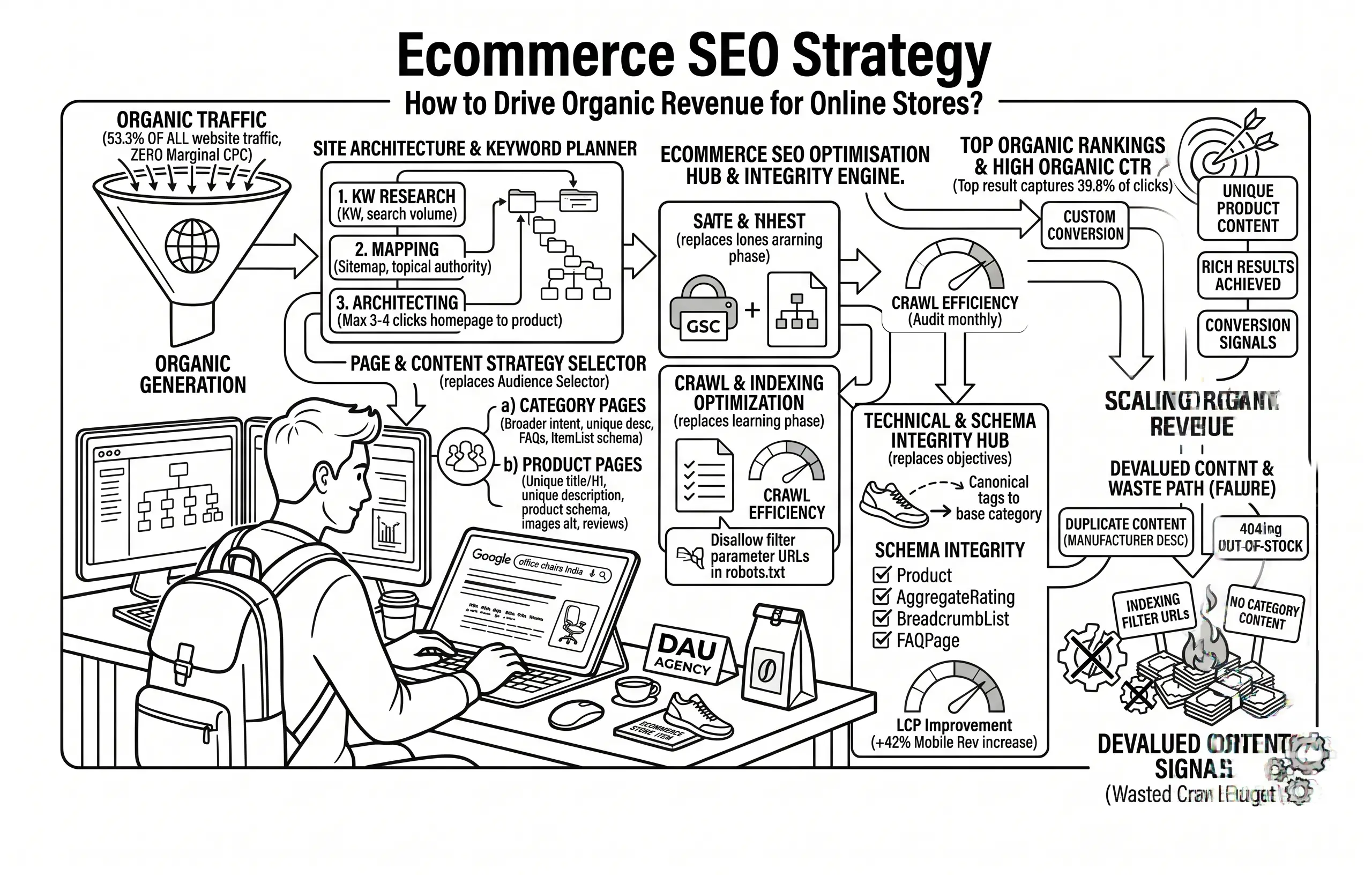


Key Takeaways
- Publishing more content is not the answer when weak pages can’t rank, earn clicks, or convert.
- Google confirms its ranking systems evaluate many factors and signals across hundreds of billions of pages.
- Google’s systems are designed to reward content that is helpful, reliable, and built for people first.
- BrightEdge reports that organic search still drives 51% of traffic on average, even as AI-powered search continues to grow.
- Ahrefs found that 96.55% of all pages receive zero organic traffic from Google.
- A strong SEO strategy therefore prioritizes quality, crawlability, authority, and conversion over page count.
Executives don’t need more SEO activity. They need better SEO decisions. Publishing more pages won’t fix weak positioning, poor site structure, slow load times, thin service pages, or low domain trust. The real job of SEO isn’t volume. It’s visibility that translates into pipeline and revenue.
The First Executive Truth: Google Does Not Rank Volume
There’s no public, ordered list of Google ranking factors. But Google is clear that its systems use many signals to rank results, and those systems are built to surface content that is helpful, reliable, and created for people.
That reframes the conversation immediately.
If your board asks whether you should publish 100 more pages, the better question is whether those pages would be more useful than what already exists. In most cases, the answer is no. That’s why more content so often produces more waste.
Ahrefs found that 96.55% of pages receive no organic traffic from Google whatsoever. Page count alone is a weak growth strategy. At the same time, BrightEdge reports that organic search still drives 51% of traffic on average, so SEO clearly matters. It just works best when quality and technical strength lead the way.
What Is SEO, Really?
SEO stands for search engine optimization. In practical terms, it helps search engines understand your site and helps the right people find it.
For executives, SEO should accomplish four things:
- Get the right pages discovered
- Help those pages rank
- Win the click
- Turn visits into measurable business outcomes
SEO optimization is not a content department project. It’s a growth system that touches brand, web, content, product, analytics, and sales.
Why More Content Often Fails
More content fails for predictable reasons.
The topic has no real search demand. The page doesn’t match what users actually want. Google can’t crawl or interpret the page properly. The title and snippet don’t earn clicks. Or the page attracts traffic but not trust.
Google’s own guidance recommends using the words people actually search for in prominent places like the title, main heading, alt text, and link text. It also notes that links need to be crawlable for Google to discover related pages. When companies keep publishing while ignoring structure, even strong ideas can quietly underperform.
This is why the most important mindset shift in SEO for executives is this: the problem is rarely content supply. It’s content fit.
The Ranking Areas That Matter Most to Leaders
Search Intent Beats Content Volume
A page ranks better when it clearly solves the intent behind the search.
A healthcare page should answer care-related questions clearly and responsibly. An education page should explain programs, outcomes, eligibility, and campus details. A real estate page should cover location context, pricing, available inventory, and next steps. The best SEO services don’t just insert keywords. They align the page with the actual question a buyer is asking.
Google states that helpful content should be created to benefit people, not to manipulate rankings. The first ranking lever is usefulness, not quantity.
On-Page SEO Earns Understanding and Clicks
On-page SEO still matters because Google reads the page you publish, not the strategy deck behind it.
Executives should expect strong on-page SEO across these elements:
- Clear, descriptive titles
- Direct, well-structured headings
- Useful, readable copy
- Descriptive internal links
- Relevant images with alt text
- Strong local or product-level detail
- Clear calls to action
Google notes that title links are often the primary factor users rely on when deciding which result to click, and that every page should have a descriptive title element. Pages that rank but don’t get clicked often have an on-page SEO problem, not just a ranking one.
Technical SEO Protects Discoverability
Strong content can’t win if Google struggles to crawl, render, or index it.
Technical SEO covers:
- Crawlability
- Indexation
- Internal linking
- Canonical tag control
- XML sitemaps
- Mobile readiness
- Structured data
- Page speed
Google finds pages through crawlable links and automated crawling. Technical SEO is not a support function. It’s revenue protection.
Core Web Vitals Help Remove Friction
Google’s Core Web Vitals measure real-world loading performance, interactivity, and visual stability. Google recommends an LCP within 2.5 seconds and an INP under 200 milliseconds.
Speed alone won’t rank a weak page. But poor page experience can hold a strong page back. Slow pages also reduce form fills and lead quality. SEO and UX need to work together.
Off-Page SEO Still Builds Authority
Off-page SEO covers the signals outside your own pages that help search engines trust your brand.
That includes:
- High-quality backlinks
- Editorial mentions
- Reviews and ratings
- Local citations
- Brand search volume
- Digital PR coverage
Google doesn’t advise chasing random links, but authority still matters. Better-known, better-cited brands tend to earn stronger visibility over time. Off-page SEO should be about building genuine reputation and proof, not gaming shortcuts.
Sector Leaders Need Different Proof, Not Just Different Keywords
The biggest mistake executives make is applying the same SEO playbook across every sector.
Education Brands Need Trust and Clarity
An SEO agency working with education brands should understand course intent, admissions timelines, campus location pages, faculty credibility signals, and student outcome content.
Strong SEO for education brands should improve:
- Course and program pages
- Campus pages
- Scholarship and financial aid pages
- FAQ pages
- Comparison pages
- Local visibility for each campus
Education SEO works when pages directly answer the questions students and parents are already asking.
Healthcare Brands Need Higher Trust Control
An SEO agency working in healthcare should have clear processes for medical content review, clinician bios, treatment pages, clinic location pages, and local reputation management.
Healthcare pages carry greater trust risk than most. They require stronger evidence, clearer authorship, tighter compliance, and precise local SEO. In healthcare, more pages without better proof usually create more risk, not more growth.
Real Estate Brands Need Market Depth
An SEO agency serving real estate brands should be able to build area pages, project pages, developer pages, pricing pages, and local demand content without defaulting to thin city-name duplication.
Real estate SEO works best when every page adds genuine local value: maps, amenities, inventory context, financing information, and neighborhood insight. Thin location pages rarely hold their rankings for long.
A Better Executive SEO Framework
The strongest SEO strategies tend to follow this order.
1. Fix the Pages Already Closest to Revenue
Start with pages already ranking on page one or two. Also prioritize pages that directly influence leads, demos, inquiries, applications, bookings, or property visits.
This creates faster results than publishing 50 new blog posts.
2. Improve Page Quality Before Publishing More
Refresh weak pages first. Merge duplicates. Remove thin content. Strengthen service and category pages. Only then publish new content where genuine search demand and business value are both clear.
Content pruning can be just as important as content creation.
3. Build Stronger Internal Linking
Google uses crawlable links to discover pages across a site. Important pages shouldn’t sit in isolation.
Link:
- Blog posts to relevant service pages
- Service pages to supporting case studies
- Location pages to local FAQs
- Parent pages to their subpages
- High-authority pages to commercial pages
This supports both discoverability and the user decision-making process.
4. Treat Search Console Like an Executive Dashboard
Google’s Performance report surfaces clicks, impressions, queries, and click-through rates. Low-CTR pages often signal a need for better titles, meta descriptions, or content alignment.
Leadership should regularly review:
- Branded vs. non-branded traffic growth
- CTR on key commercial pages
- Page performance by revenue stage
- Device-level trends
- Query shifts over time
- Location-level performance where relevant
Search Console retains only 16 months of data, so serious teams should archive longer-term SEO data separately.
5. Demand Business Reporting, Not Ranking Theatre
Strong SEO services don’t stop at keyword position charts.
Executives should be asking for:
- Qualified organic leads
- Organic pipeline influence
- Application start rates
- Appointment requests
- Booking completions
- Property inquiry volume
- Assisted conversions
- Landing page conversion rates
That’s how SEO earns its place as a board-level growth channel.
Did You Know? Google’s Search Quality Rating process involves approximately 16,000 external Search Quality Raters. Their feedback doesn’t directly influence how individual pages rank, but it helps Google assess whether its systems are consistently surfacing better results.
What to Ask Before Hiring an SEO Agency
A strong SEO partner should explain their work in business terms.
Ask these questions:
- Which of our pages are closest to revenue right now?
- Which pages already have realistic ranking potential?
- What technical issues are currently limiting growth?
- What should we improve before we publish anything new?
- How will you measure pipeline impact, not just traffic?
- What does your on-page and off-page SEO approach look like?
- Which SEO services will address our specific sector first?
If you’re comparing a generalist agency against a sector-specialist, ask for proof of relevant experience. A generalist may understand the fundamentals. But sector-specific strategy tends to produce faster results in education, healthcare, and real estate.
The Simplest Answer Executives Should Remember
More content is not the answer when a site lacks clarity, authority, speed, trust, and clear conversion paths.
That’s why SEO for executives should focus on fewer, stronger decisions:
- Improve search intent alignment
- Strengthen on-page SEO
- Fix technical SEO issues
- Build better internal linking
- Earn stronger off-page authority
- Measure business impact, not just traffic
When those elements work together, SEO scales. When they don’t, more content only conceals the underlying problem.
Conclusion
SEO works best when leaders treat it as a quality system, not a publishing quota.
Google’s guidance is consistent: search rewards helpful content, clear titles, crawlable links, and strong page experience. The data supports this too. Organic search still drives significant traffic, yet the vast majority of pages receive none. The executive move is straightforward: stop defaulting to more content. Start demanding better pages, stronger structure, and more credible proof.
That is the SEO strategy built on the ranking factors that actually matter.
FAQs
What is SEO in simple words?
SEO is search engine optimization. It helps search engines understand your site and helps the right users find your pages at the right moment.
Is more content ever the right SEO strategy?
Yes, but only after page quality, technical SEO, and search intent alignment are already solid. Otherwise, more content typically adds more low-value pages that dilute the site’s overall strength.
What is the difference between on-page SEO and off-page SEO?
On-page SEO covers everything on the page itself, including titles, headings, copy, and internal links. Off-page SEO covers authority signals that exist outside your site, such as backlinks, editorial mentions, and reviews.
What should SEO services include for executive teams?
Good SEO services should cover technical audits, content quality improvements, internal linking strategy, authority building, Search Console analysis, and business reporting tied to leads or revenue outcomes.
How should I evaluate an SEO agency for education brands?
Look for an agency that understands course intent, campus page strategy, student and parent questions, admission journey content, and local SEO for educational institutions.
What should I expect from an SEO agency for healthcare brands?
Expect strong trust controls, accurate treatment pages, verified clinician profiles, a clear location strategy, and careful review management workflows.
What makes an SEO agency for real estate different?
A strong real estate SEO agency knows how to build local area pages, project pages, pricing context, and neighborhood content without producing thin, duplicated city-level pages.
References
- Google Search Central, “A Guide to Google Search Ranking Systems” https://developers.google.com/search/docs/appearance/ranking-systems-guide
- Google Search Central, “Creating Helpful, Reliable, People-First Content” https://developers.google.com/search/docs/fundamentals/creating-helpful-content
- Google Search Central, “Search Engine Optimization (SEO) Starter Guide” https://developers.google.com/search/docs/fundamentals/seo-starter-guide
- Google Search Central, “Google Search Essentials” https://developers.google.com/search/docs/essentials
- Google Search Central, “Understanding Core Web Vitals and Google Search Results” https://developers.google.com/search/docs/appearance/core-web-vitals
- Google Search Central, “Influencing Your Title Links in Search Results” https://developers.google.com/search/docs/appearance/title-link
- Google Search Console Help, “Performance Report (Search Results)” https://support.google.com/webmasters/answer/7576553?hl=en
- Google Search Blog, “Our Latest Update to the Quality Rater Guidelines: E-E-A-T Gets an Extra E for Experience” https://developers.google.com/search/blog/2022/12/google-raters-guidelines-e-e-a-t
- Google, “Search Quality Rater Guidelines: An Overview” https://services.google.com/fh/files/misc/hsw-sqrg.pdf
- BrightEdge, “SEO Research Reports” https://www.brightedge.com/resources/research-reports
- Ahrefs, “96.55% of Content Gets No Traffic From Google” https://ahrefs.com/blog/search-traffic-study/
- HubSpot, “2026 Marketing Statistics, Trends, & Data” https://www.hubspot.com/marketing-statistics