

Consumers now use an average of six touchpoints to research a product, and 50% rely on four or more channels before making a decision, according to research compiled by SEOptimer. Google’s share of general information searches fell from 73% to 66.9% between February and August 2025, per Search Atlas research. ChatGPT usage for general searches tripled from 4.1% to 12.5% in the same period. If your brand only optimises for Google, it is invisible on every other surface where buying decisions are being influenced.
Key Takeaways
- Consumers use an average of six touchpoints to research a product, and 50% rely on four or more channels, according to SEOptimer research.
- Google’s share of general information searches fell from 73% to 66.9% between February and August 2025, according to Search Atlas.
- ChatGPT usage for general searches tripled from 4.1% to 12.5% in just six months of 2025.
- 43% of Gen Z use TikTok as a primary search tool, and 61% of Instagram users turn to the platform for product discovery, according to GWI data.
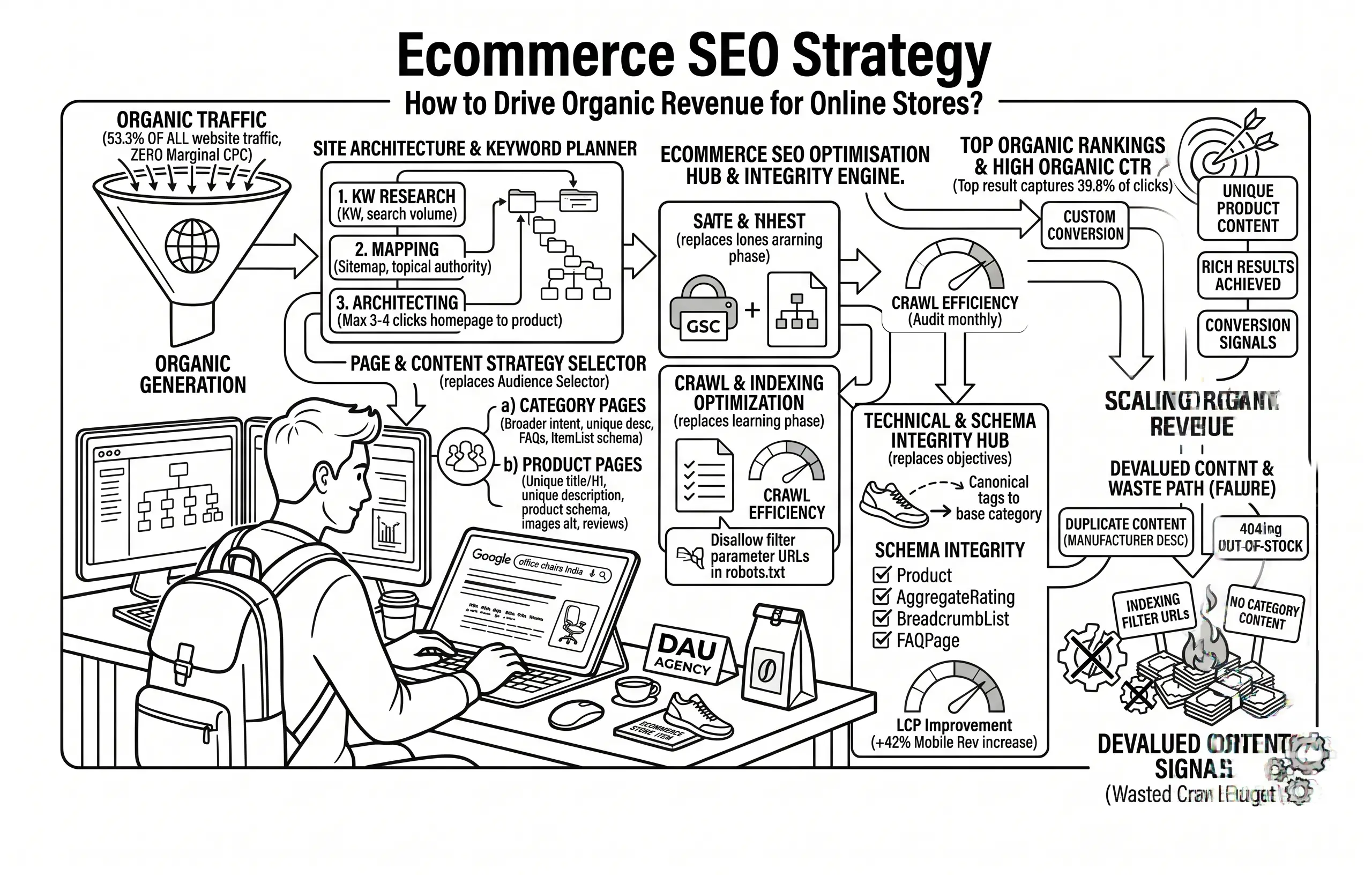
- According to BrightEdge, organic search still drives 53.3% of all website traffic – Google optimisation is foundational, not optional.
What Is Search Everywhere Optimization?
The practice of making your brand discoverable across all platforms where your audience searches – Google, AI tools, social platforms, marketplaces, and voice assistants. Not superficially everywhere, but optimised correctly for the specific platforms where your audience actually searches.
Why Google Alone Is No Longer Sufficient
The Data on Platform Fragmentation
Google’s share of general information searches dropped from 73% to 66.9% between February and August 2025, per Search Atlas. Daily AI tool usage doubled from 14% to 29.2% in 2025. 71.5% of US consumers have used AI search tools. Google still leads – driving 63% of referral traffic according to SEOptimer – but the search journey is increasingly multi-platform.
Social as Search
According to GWI data, 43% of Gen Z use TikTok as their primary search tool, and 46% of Gen Z starts product research on TikTok or Instagram. For brands whose primary audience includes younger consumers, social search optimisation is not optional.
AI as the New Research Interface
ChatGPT usage for general searches tripled from 4.1% to 12.5% in just six months, per Search Atlas. ChatGPT now handles approximately 2.5 billion daily queries. The shift is concentrated in B2B, education, healthcare, and technology categories.
The Search Everywhere Optimization Framework
Layer 1 – Google (Foundation)
According to BrightEdge, 53.3% of all website traffic comes from organic search. Technical SEO, content depth, and authority building remain foundational. Nothing built on other platforms compensates for a weak Google foundation.
Layer 2 – AI Search (Visibility in Answers)
The Princeton/Georgia Tech/IIT Delhi KDD 2024 study found that adding statistics to content increased AI visibility by 32%, adding citations by 30%, and adding expert quotations by 41%. Brands cited in AI-generated answers experience a 38% lift in organic clicks, per Relixir’s 2025 research.
Layer 3 – Social Search (Discovery and Awareness)
YouTube, Instagram, TikTok, and LinkedIn each have search functions with significant audience segments. Google Lens now processes over 20 billion visual searches per month. Optimisation requires keyword-rich profiles, format-native content, and consistent publishing.
Layer 4 – Marketplace and App Search
For ecommerce brands, marketplace search on Amazon and Flipkart is a high-intent channel. For app-based businesses, app store search drives organic installs. Each has its own keyword logic and ranking signals.
Layer 5 – Local and Voice Search
46% of all Google searches have local intent. Businesses appearing in the Google 3-Pack earn 44% of clicks for local-intent queries, according to Moz data. 58% of consumers used voice search to find local business information in the past year, per BrightLocal.
How to Build a Search Everywhere Strategy
- Map where your audience searches – B2B prioritises LinkedIn, Google, and AI tools; D2C consumer brands prioritise Instagram, TikTok, and marketplace search
- Audit current visibility per platform – GSC for Google, GA4 for referral sources, social analytics for platform search visibility
- Build platform-specific content – long-form for Google, short-form video for social, structured Q&A for AI, keyword-rich listings for marketplaces
- Maintain entity consistency – entity-driven content improved AI citation likelihood by 35%+ per Search Engine Land, October 2025
- Measure platform by platform – AI referral traffic in GA4, social search engagement, marketplace impressions, branded search volume growth
Common Mistakes
- Spreading effort too thin: identify two to three non-Google platforms relevant to your audience and build depth before expanding
- Repurposing without adaptation: the same content cross-posted to every platform underperforms on all of them
- Treating AI visibility as separate from SEO: AI tools predominantly retrieve from Google-indexed content – the two strategies are additive
- No measurement: AI referral converts at 15.9% on ChatGPT vs. 1.76% Google organic per Seer Interactive – if you are not tracking it, you are missing a high-converting channel
Best Practices
- Build your Google technical SEO foundation first – every other platform’s effectiveness depends on it.
- Focus on two to three additional platforms initially – depth beats shallow presence on many.
- Publish consistently – activity signals matter to platform algorithms and Google’s entity recognition.
- Update your measurement approach every six months – AI and social search metrics are evolving quickly.
For how Google-specific SEO supports the broader multi-location strategy, see our guide on SEO for multi-location brands: dauagency.com/seo-for-multi-location/
How DAU Agency Can Help
DAU Agency builds multi-platform search strategies starting with a strong Google foundation and extending to AI search readiness, social discovery, and local search. Visit our search everywhere optimisation service: dauagency.com/services/seo-search-everywhere-optimization/
Conclusion
Google still drives 53.3% of all website traffic. But 43% of Gen Z use TikTok as their primary search tool, ChatGPT usage tripled in six months, and consumers research across an average of six touchpoints. The brands building visibility across all relevant surfaces will outperform those optimising for only one.
Sources
- Search Atlas – Search Behaviour Evolution 2025
- SEOptimer – Search Everywhere Optimization Guide
- BrightEdge – Organic Traffic Share
- Aggarwal et al., KDD 2024
- Relixir 2025 – AI Citation Click Lift
- Conductor 2026 – AI Referral Benchmark
- Seer Interactive 2025 – LLM Conversion Rates
- GWI 2025 – Gen Z Search Behaviour
- BrightLocal – Voice Search Survey 2025
- Moz – Local Pack CTR
- Search Engine Land – Entity Content and AI Citation, October 2025